 CalcKit
Cylinder Calculator
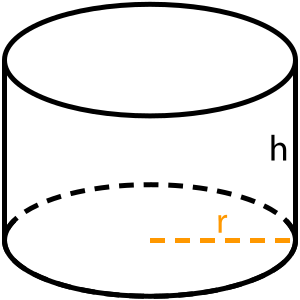



Table of Contents
Cylinder definition
A cylinder is a three-dimensional shape with two identical, parallel circular bases joined by a curved surface.
This tool works with the right circular cylinder: its bases are circles centred one directly above the other, and its curved side stands at right angles to them. It is the shape you get by spinning a rectangle around one of its sides.
A right circular cylinder has the following properties:
- Two flat faces, the circular bases, and one curved surface
- Two curved edges, around the bases, and no vertices
- Every slice parallel to the bases is the same circle
- Unrolled, its curved surface is a rectangle, with the circumference of the base as one side and the height as the other
A cylinder is a prism with a circle as its base, and a cone with the same base and height holds exactly one third of its volume. A cylinder cut by a slanted plane is a truncated cylinder.
Parts of a cylinder
The five parts of a cylinder mentioned in this tool are the radius (r), height (h), lateral area (Al), total area (A) and volume (V).
Radius (r)
The radius of a cylinder is the radius of its circular bases.
It can be found with the following formulas:
-
If you know the lateral area and the height:
r = Al / (2 * π * h) -
If you know the volume and the height:
r = √(V / (π * h)) -
If you know the total area and the lateral area:
r = √((A - Al) / (2 * π))
Height (h)
The height of a cylinder is the perpendicular distance between its two bases.
It can be found with the following formulas:
-
If you know the lateral area and the radius:
h = Al / (2 * π * r) -
If you know the volume and the radius:
h = V / (π * r²) -
If you know the total area and the radius:
h = (A - 2 * π * r²) / (2 * π * r)
Lateral area (Al)
The lateral area of a cylinder is the area of its curved side only, without the two bases. Unrolled, it is a rectangle whose sides are the circumference of the base and the height:
Al = 2 * π * r * h
Area (A)
The area (total surface area) of a cylinder is its lateral area plus the areas of the two circular bases:
A = Al + 2 * π * r²
Volume (V)
The volume of a cylinder is the amount of space inside it. It is the area of the base times the height:
V = π * r² * h
Types of cylinders
-
Right circular cylinder: the bases are circles directly above each other. This is the cylinder most people mean, and the one this tool calculates.
-
Oblique cylinder: the top base is shifted sideways, so the cylinder leans. Its volume is still
π * r² * h, with h measured straight up. -
Hollow cylinder (tube): a cylinder with a smaller cylinder removed from its middle, like a pipe. Its volume is the difference of the two:
π * (R² - r²) * h. -
Elliptic cylinder: the bases are ellipses instead of circles.
Cylinders are among the most common shapes in daily life: cans, pipes, glasses, batteries, candles, tanks and the pistons in an engine.
Frequently asked questions
How do you find the volume of a cylinder?
Multiply the area of the base by the height: V = π * r² * h. A can with r = 3 cm and h = 10 cm holds π × 3² × 10 ≈ 282.74 cm³, or 0.28 litres.
How do you find the surface area of a cylinder?
Add the curved side and the two bases: A = 2 * π * r * h + 2 * π * r². For r = 3 and h = 10, that is 2 × π × 3 × 10 + 2 × π × 3² ≈ 245.04 square units.
How do you find the height of a cylinder from its volume?
Divide the volume by the area of the base: h = V / (π * r²). A cylinder that holds 1 litre (1000 cm³) with r = 5 cm is 1000 / (π × 5²) ≈ 12.73 cm tall.
How many faces, edges and vertices does a cylinder have?
A cylinder has two flat faces and one curved surface, two curved edges and no vertices.