 CalcKit
Conical Frustum Calculator
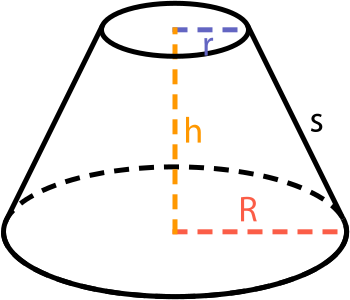



Table of Contents
- Conical frustum definition
- Parts of a conical frustum
- Where conical frustums are found
- Frequently asked questions
Conical frustum definition
A conical frustum (or truncated cone) is what is left of a cone when its top is cut off by a plane parallel to its base.
A conical frustum has two parallel circular faces of different sizes, the larger base and the smaller top, joined by a sloping curved side. This tool works with the frustum of a right circular cone, where the two circles are centred one above the other.
The word frustum comes from Latin and means "a piece cut off". When the top radius shrinks to zero, the frustum becomes a full cone; when both radii are equal, it becomes a cylinder.
Parts of a conical frustum
The seven parts of a conical frustum mentioned in this tool are the base radius (R), top radius (r), height (h), slant height (s), lateral area (Al), total area (A) and volume (V).
Base radius (R)
The base radius is the radius of the larger circular face of the frustum.
It can be found with the following formulas:
-
If you know the lateral area, the slant height and the top radius:
R = Al / (π * s) - r -
If you know the total area, the lateral area and the top radius:
R = √((A - Al - π * r²) / π)
Top radius (r)
The top radius is the radius of the smaller circular face of the frustum.
It can be found with the following formulas:
-
If you know the lateral area, the slant height and the base radius:
r = Al / (π * s) - R -
If you know the total area, the lateral area and the base radius:
r = √((A - Al - π * R²) / π)
Height (h)
The height of a conical frustum is the perpendicular distance between its two circular faces.
If you know the slant height and both radii:
h = √(s² - (R - r)²)
Slant height (s)
The slant height is the distance between the edges of the two circles, measured along the sloping side.
It can be found with the following formulas:
-
If you know the height and both radii:
s = √(h² + (R - r)²) -
If you know the lateral area and both radii:
s = Al / (π * (R + r))
Lateral area (Al)
The lateral area of a conical frustum is the area of its curved side only, without the two circles:
Al = π * s * (R + r)
Area (A)
The area (total surface area) of a conical frustum is its lateral area plus the areas of both circular faces:
A = Al + (π * r²) + (π * R²)
Volume (V)
The volume of a conical frustum is the amount of space inside it.
If you know the height and both radii:
V = π * h * (R² + (R * r) + r²) / 3
Where conical frustums are found
Conical frustums are one of the most common shapes in everyday objects:
- Buckets, cups and flower pots: wider at the top than at the bottom, so they stack inside each other.
- Lampshades and lamp bases.
- Funnels and nozzles, where only the wide part is a frustum.
- Cooling towers, chimneys and the bases of many towers.
- Traffic cones with a flat top, and the paper cups used in water dispensers.
The volume formula is useful for working out how much a bucket or a planter holds, and the lateral area for how much material is needed to make a lampshade.
Frequently asked questions
How do you find the volume of a conical frustum?
Use V = π * h * (R² + (R * r) + r²) / 3, where R and r are the two radii and h the height. For R = 5, r = 3 and h = 4, that is π × 4 × (5² + 5 × 3 + 3²) / 3 ≈ 205.25 cubic units.
How do you find the slant height of a frustum?
The slant height is the hypotenuse of a right triangle whose legs are the height and the difference of the radii: s = √(h² + (R - r)²).
What is the difference between a cone and a frustum?
A cone narrows to a single point at the top. A frustum is a cone with that point cut off, so it has a flat circular top as well as its base.
How much does a bucket hold?
Treat it as a conical frustum. Measure the radius of the bottom, the radius of the top and the height, and use the volume formula above. With the measurements in centimetres, divide the result by 1000 to get litres.