 CalcKit
Ellipse Calculator
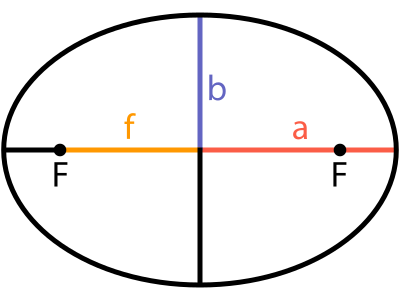



Table of Contents
Ellipse definition
An ellipse is a closed, oval curve in a plane, around two fixed points called the foci (one focus, two foci). For every point on the ellipse, the distances to the two foci add up to the same number, which equals the length of its longest diameter.
This is also how to draw one: pin both ends of a loop of string at the two foci, pull it tight with a pencil and move the pencil around.
An ellipse has the following properties:
- It is symmetrical about two perpendicular axes: the major axis, its longest diameter, which passes through both foci, and the minor axis, its shortest diameter
- The two axes cross at the centre of the ellipse
- The closer the foci are to each other, the rounder the ellipse; when they meet at the centre, the ellipse becomes a circle
An ellipse is one of the conic sections: it is the shape you get when you slice a cone at an angle, without cutting through its base.
Parts of an ellipse
The six parts of an ellipse mentioned in this tool are the semi-major axis (a), semi-minor axis (b), linear eccentricity (f), numerical eccentricity (ε), area (A) and circumference (C).
Semi-major axis (a)
The semi-major axis is half of the major axis: the distance from the centre of the ellipse to its farthest point. It is the ellipse's largest radius.
It can be found with the following formulas:
-
If you know the area and the semi-minor axis:
a = A / (π * b) -
If you know the linear eccentricity and the semi-minor axis:
a = √(f² + b²) -
If you know the linear and the numerical eccentricity:
a = f / ε
Semi-minor axis (b)
The semi-minor axis is half of the minor axis: the distance from the centre of the ellipse to its nearest point on the curve. It is the ellipse's smallest radius.
It can be found with the following formulas:
-
If you know the area and the semi-major axis:
b = A / (π * a) -
If you know the semi-major axis and the linear eccentricity:
b = √(a² - f²)
Linear eccentricity (f)
The linear eccentricity is the distance from the centre of the ellipse to either focus.
It can be found with the following formulas:
-
If you know both semi-axes:
f = √(a² - b²) -
If you know the numerical eccentricity and the semi-major axis:
f = ε * a
Numerical eccentricity (ε)
The numerical eccentricity (or simply the eccentricity) describes how stretched the ellipse is, as a number from 0 to 1. A circle has an eccentricity of 0, and the closer it gets to 1, the longer and flatter the ellipse.
If you know the linear eccentricity and the semi-major axis:
ε = f / a
Area (A)
The area of an ellipse is the space enclosed by its curve. It is the circle's formula, with the two semi-axes in place of the radius squared:
A = π * a * b
Circumference (C)
The circumference (or perimeter) of an ellipse is the length of its curve. Unlike the circle, it has no simple exact formula, so this tool uses Ramanujan's second approximation, which is accurate to a tiny fraction for any ellipse. With λ = (a - b) / (a + b):
C ≈ π * (a + b) * (1 + 3 * λ² / (10 + √(4 - 3 * λ²)))
When a = b, λ = 0 and the formula becomes the circle's 2 * π * a.
Where ellipses are found
- Planetary orbits: every planet moves around the Sun on an ellipse, with the Sun at one focus. The Earth's orbit has an eccentricity of only about 0.017, which is almost a circle.
- Circles seen at an angle: the top of a glass or a round table looks like an ellipse when it isn't seen from straight above.
- Whispering galleries: a sound made at one focus of an elliptical room bounces off the walls and arrives at the other focus.
- Engineering and design: elliptical gears, arches, running tracks and the shape of many logos and mirrors.
Frequently asked questions
How do you find the area of an ellipse?
Multiply π by the two semi-axes: A = π * a * b. An ellipse with a = 5 and b = 3 has an area of π × 5 × 3 ≈ 47.12 square units.
How do you find the circumference of an ellipse?
There is no exact simple formula, but Ramanujan's approximation is very accurate: C ≈ π * (a + b) * (1 + 3 * λ² / (10 + √(4 - 3 * λ²))), with λ = (a - b) / (a + b). For a = 5 and b = 3, the circumference is about 25.53 units.
How do you find the foci of an ellipse?
Both foci lie on the major axis, at a distance of f = √(a² - b²) from the centre. For a = 5 and b = 3, the foci are √(5² - 3²) = 4 units from the centre on each side.
What is the eccentricity of an ellipse?
It is the ratio of the focus distance to the semi-major axis, ε = f / a, a number between 0 and 1 that says how stretched the ellipse is. A circle has 0, and an ellipse with a = 5 and b = 3 has 4 / 5 = 0.8.