 CalcKit
Truncated Cylinder Calculator
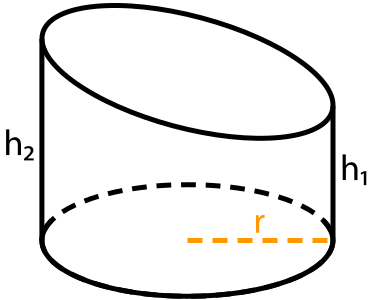



Table of Contents
- Truncated cylinder definition
- Parts of a truncated cylinder
- Where truncated cylinders are found
- Frequently asked questions
Truncated cylinder definition
A truncated cylinder is what is left of a cylinder when it is cut by a plane that is not parallel to its base. It is also known as a cylindrical segment or an obliquely cut cylinder.
The bottom of a truncated cylinder is still a circle, but the cut top is tilted, so the height is different on each side: it is shortest on one side (h1) and longest on the opposite side (h2). The tilted top face is not a circle but an ellipse.
When both heights are the same, the cut is parallel to the base and the shape is an ordinary cylinder again. The formulas below then give exactly the cylinder's results.
Parts of a truncated cylinder
The six parts of a truncated cylinder mentioned in this tool are radius (r), short height (h1), long height (h2), lateral area (Al), total surface area (A) and volume (V).
Radius (r)
The radius of a truncated cylinder is the radius of its circular base, the distance from the centre of the base to its edge.
It can be found with the following formulas:
-
If you know the volume and both heights:
r = √(2 * V / (π * (h1 + h2))) -
If you know the lateral area and both heights:
r = Al / (π * (h1 + h2))
Height (h1)
The short height (h1) is the height of the truncated cylinder on its lowest side, measured from the base to the cut.
It can be found with the following formulas:
-
If you know the volume, the radius and the long height:
h1 = 2 * V / (π * r²) - h2 -
If you know the lateral area, the radius and the long height:
h1 = Al / (π * r) - h2
Height (h2)
The long height (h2) is the height of the truncated cylinder on its highest side, opposite the short height.
It can be found with the following formulas:
-
If you know the volume, the radius and the short height:
h2 = 2 * V / (π * r²) - h1 -
If you know the lateral area, the radius and the short height:
h2 = Al / (π * r) - h1
Lateral area (Al)
The lateral area of a truncated cylinder is the area of its curved side only, without the base and the cut top.
It is the same as the lateral area of a cylinder whose height is the average of the two heights:
Al = π * r * (h1 + h2)
Area (A)
The area (total surface area) of a truncated cylinder is the sum of its lateral area, its circular base and its elliptical top.
The top is an ellipse with semi-axes r and √(4 * r² + (h2 - h1)²) / 2, so the total area is:
A = Al + (π * r²) + (π * r * √(4 * r² + (h2 - h1)²) / 2)
Volume (V)
The volume of a truncated cylinder is the amount of space inside it.
It equals the volume of a cylinder with the average height of the two sides:
V = π * r² * (h1 + h2) / 2
Where truncated cylinders are found
Truncated cylinders appear wherever a pipe, a tube or a round post is cut at an angle:
- Pipes and ducts: a pipe cut at an angle to make an elbow joint is a truncated cylinder, and its lateral area is the amount of sheet material needed.
- Tanks and silos: a cylindrical tank with a sloping top or bottom holds the volume of a truncated cylinder.
- Woodwork and metalwork: a round bar or a log sawn at an angle.
- Liquid in a tilted glass: the liquid in a cylindrical glass that is tilted, as long as it still covers the whole bottom, has the shape of a truncated cylinder.
Frequently asked questions
How do you find the volume of a truncated cylinder?
Multiply the base area by the average of the two heights: V = π * r² * (h1 + h2) / 2. For example, with r = 3, h1 = 4 and h2 = 7, the volume is π × 3² × (4 + 7) / 2 ≈ 155.51 cubic units.
Is a truncated cylinder the same as a cylindrical segment?
Yes, both names describe a cylinder cut by a plane that is not parallel to its base. It is also sometimes called an oblique cut cylinder.
What shape is the top of a truncated cylinder?
An ellipse. Its short semi-axis is the radius of the cylinder, and its long semi-axis grows with the difference between the two heights.