 CalcKit
Cone Calculator
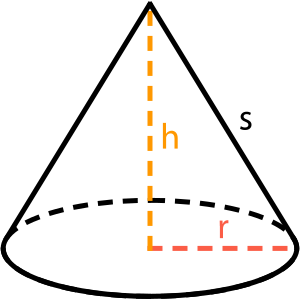



Table of Contents
Cone definition
A cone is a three-dimensional shape that narrows smoothly from a flat circular base to a single point, called the apex (or vertex).
This tool works with the right circular cone: its base is a circle, and its apex sits directly above the centre of the base. It is the shape you get by spinning a right triangle around one of its legs.
A right circular cone has the following properties:
- One flat face, the circular base, and one curved surface
- One curved edge, around the base, and one vertex, the apex
- Every straight line from the apex to the edge of the base has the same length, the slant height
- Unrolled, its curved surface is a circular sector
A cone is closely related to the cylinder and the pyramid: it holds exactly one third of the volume of a cylinder with the same base and height, just as a pyramid holds one third of a prism. A cone with its top cut off is a conical frustum.
Parts of a cone
The five parts of a cone mentioned in this tool are the radius (r), height (h), slant height (s), area (A) and volume (V).
Radius (r)
The radius of a cone is the radius of its circular base.
It can be found with the following formulas:
-
If you know the slant height and the height:
r = √(s² - h²) -
If you know the volume and the height:
r = √(3 * V / (π * h))
Height (h)
The height of a cone is the perpendicular distance from the apex down to the centre of the base.
It can be found with the following formulas:
-
If you know the slant height and the radius:
h = √(s² - r²) -
If you know the volume and the radius:
h = 3 * V / (π * r²)
Slant height (s)
The slant height of a cone is the distance from the apex to any point on the edge of the base, measured along the curved surface. The radius, the height and the slant height form a right triangle, with the slant height as its hypotenuse.
It can be found with the following formulas:
-
If you know the radius and the height:
s = √(r² + h²) -
If you know the total area and the radius:
s = (A - π * r²) / (π * r)
Area (A)
The area (total surface area) of a cone is the area of its curved surface, π * r * s, plus the area of its circular base, π * r²:
A = π * r * (s + r)
Volume (V)
The volume of a cone is the amount of space inside it. It is one third of the base area times the height:
V = π * r² * h / 3
Types of cones
-
Right circular cone: the apex is directly above the centre of a circular base. This is the cone most people mean, and the one this tool calculates.
-
Oblique cone: the apex is shifted to one side, so the cone leans. Its volume is still
π * r² * h / 3, but its slant height is different all the way around. -
Elliptic cone: the base is an ellipse instead of a circle.
Cones are everywhere: ice cream cones, traffic cones, funnels, party hats, volcanoes, the tip of a pencil and the beam of light from a torch.
Frequently asked questions
How do you find the volume of a cone?
Multiply the area of the base by the height and divide by three: V = π * r² * h / 3. A cone with r = 3 and h = 4 holds π × 3² × 4 / 3 ≈ 37.70 cubic units.
How do you find the slant height of a cone?
Use the Pythagorean theorem on the radius and the height: s = √(r² + h²). For r = 3 and h = 4, that is √(3² + 4²) = 5.
How do you find the surface area of a cone?
Add the curved surface and the base: A = π * r * (s + r). For r = 3 and s = 5, that is π × 3 × (5 + 3) ≈ 75.40 square units, of which the curved surface alone is π × 3 × 5 ≈ 47.12.
Why is the volume of a cone one third of a cylinder?
A cone can be thought of as a pyramid with a base of infinitely many sides, and every pyramid holds one third of the prism with the same base and height. You can check it by filling a cone with water three times: it fills a cylinder with the same base and height exactly.