 CalcKit
Prism Calculator
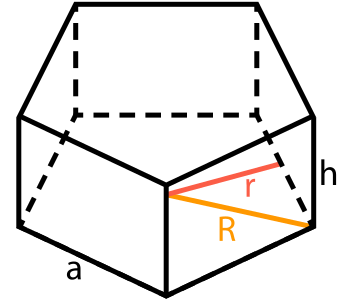


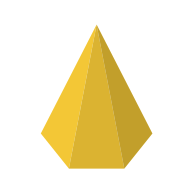

Table of Contents
Prism definition
A prism is a three-dimensional shape with two identical, parallel polygons as its ends, called the bases, joined by flat side faces. Every slice of a prism parallel to its bases is the same polygon as the bases.
This tool works with the right regular prism: its bases are regular polygons, with all sides and angles equal, and its side faces are rectangles standing at right angles to the bases.
A prism with an n-sided base has the following properties:
n + 2faces: the two bases and n rectangular side faces3nedges2nvertices
A prism is named after its base: a triangular prism has a triangle as its base, a hexagonal prism a hexagon. A square prism is a cuboid with two square ends, and a square prism whose height equals its side is a cube.
Parts of a prism
The eight parts of a prism mentioned in this tool are the number of sides of the base (n), side length (a), height (h), lateral area (Al), total area (A), volume (V), and the apothem (r) and radius (R) of the base.
Number of sides
The number of sides (n) is the number of sides of the base polygon, which is also the number of rectangular side faces.
It can be found with the following formulas:
-
If you know the lateral area, the side length and the height:
n = Al / (a * h) -
If you know the volume, the side length, the apothem and the height:
n = 2 * V / (a * r * h) -
If you know the total area, the lateral area, the side length and the apothem:
n = (A - Al) / (a * r)
Side length (a)
The side length is the length of one side of the base polygon.
It can be found with the following formulas:
-
If you know the radius and the apothem:
a = 2 * √(R² - r²) -
If you know the lateral area, the number of sides and the height:
a = Al / (n * h) -
If you know the radius and the number of sides:
a = 2 * R * sin(180° / n) -
If you know the apothem and the number of sides:
a = 2 * r * tan(180° / n)
Height (h)
The height of a prism is the distance between its two bases, which in a right prism is also the length of its side edges.
It can be found with the following formulas:
-
If you know the lateral area, the number of sides and the side length:
h = Al / (n * a) -
If you know the volume, the side length, the number of sides and the apothem:
h = 2 * V / (n * a * r) -
If you know the volume, the number of sides and the radius:
h = 2 * V / (n * R² * sin(360° / n)) -
If you know the total area, the side length, the number of sides and the apothem:
h = A / (n * a) - r
Lateral area (Al)
The lateral area of a prism is the area of its side faces only, without the two bases. Each side face is a rectangle of a by h:
Al = n * a * h
Area (A)
The area (total surface area) of a prism is its lateral area plus the area of both bases. Each base has an area of n * a * r / 2:
A = Al + n * a * r
Volume (V)
The volume of a prism is the amount of space inside it. It is the area of a base times the height:
V = n * a * r * h / 2
Apothem (r)
The apothem of the base is the distance from the centre of the base polygon to the middle of one of its sides, the radius of the circle that fits inside the base.
It can be found with the following formulas:
-
If you know the side length and the number of sides:
r = a / (2 * tan(180° / n)) -
If you know the radius and the side length:
r = √(R² - a² / 4)
Radius (R)
The radius of the base is the distance from the centre of the base polygon to one of its corners, the radius of the circle that passes through all of them.
It can be found with the following formulas:
-
If you know the side length and the number of sides:
R = a / (2 * sin(180° / n)) -
If you know the apothem and the side length:
R = √(r² + a² / 4)
Types of prisms
-
By the base: a triangular prism (3 sides), a square prism (4 sides), a pentagonal prism (5 sides), a hexagonal prism (6 sides), and so on. The more sides the base has, the closer the prism comes to a cylinder.
-
Right or oblique: in a right prism the side faces are rectangles at right angles to the bases. In an oblique prism the bases are shifted, so the side faces are parallelograms and the prism leans. Its volume is still the base area times the height.
-
Regular or irregular: a regular prism has regular polygons as its bases; an irregular prism has bases whose sides differ.
Prisms appear in everyday life as tents and Toblerone boxes (triangular), pencils and honeycomb cells (hexagonal), and the glass prisms that split light into a rainbow.
Frequently asked questions
How do you find the volume of a prism?
Multiply the area of the base by the height. For a right regular prism, the base area is n * a * r / 2, so V = n * a * r * h / 2. A hexagonal prism with a = 2 and h = 10 has an apothem of r ≈ 1.732, so it holds 6 × 2 × 1.732 × 10 / 2 ≈ 103.92 cubic units.
How do you find the surface area of a prism?
Add the lateral area, n * a * h, to the area of the two bases: A = n * a * h + n * a * r. For the same hexagonal prism, that is 6 × 2 × 10 + 6 × 2 × 1.732 ≈ 140.78 square units.
What is the difference between a prism and a pyramid?
A prism has two identical bases joined by rectangles, so it is the same shape all the way up. A pyramid has a single base, and its triangular side faces meet at a point. A pyramid holds exactly one third of the volume of a prism with the same base and height.
Is a cube a prism?
Yes. A cube is a square prism whose height equals the length of its base sides, so all six of its faces are squares.