 CalcKit
Pyramid Calculator
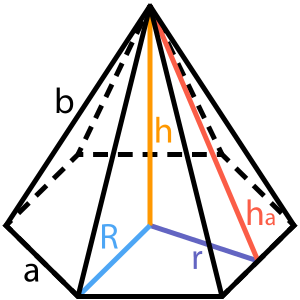



Table of Contents
Pyramid definition
A pyramid is a three-dimensional shape with a polygon as its base and triangular faces that meet at a single point above the base, called the apex.
This tool works with a right regular pyramid: its base is a regular polygon, with all sides and angles equal, and its apex sits directly above the centre of the base. All its triangular side faces are then identical isosceles triangles.
A pyramid is named after its base: a triangular pyramid has a triangle as its base (with four equal triangles it is a tetrahedron), a square pyramid has a square, like the Great Pyramids of Giza, and a hexagonal pyramid has a hexagon.
Parts of a pyramid
The ten parts of a pyramid mentioned in this tool are the number of sides of the base (n), base length (a), edge height (b), height (h), slant height (ha), base area (Ab), total area (A), volume (V), apothem (r) and radius (R) of the base.
Number of sides
The number of sides (n) is the number of sides of the base polygon, which is also the number of triangular side faces. A square pyramid has 4, a pentagonal pyramid 5.
It can be found with the following formulas:
-
If you know the total area, the base area, the base length and the slant height:
n = 2 * (A - Ab) / (a * ha) -
If you know the base length and the apothem:
n = 180° / arctan(a / (2 * r)) -
If you know the base length and the radius:
n = 180° / arcsin(a / (2 * R))
Base length (a)
The base length is the length of one side of the base polygon.
It can be found with the following formulas:
-
If you know the edge height and the slant height:
a = 2 * √(b² - ha²) -
If you know the number of sides and the base area:
a = √(4 * Ab * tan(180° / n) / n) -
If you know the number of sides and the apothem:
a = 2 * r * tan(180° / n) -
If you know the number of sides and the radius:
a = 2 * R * sin(180° / n) -
If you know the radius and the apothem:
a = 2 * √(R² - r²)
Edge height (b)
The edge height is the length of a lateral edge, the edge that runs from a corner of the base up to the apex.
If you know the height and the radius of the base:
b = √(h² + R²)
Height (h)
The height of a pyramid is the perpendicular distance from the apex down to the centre of the base.
It can be found with the following formulas:
-
If you know the slant height and the apothem:
h = √(ha² - r²) -
If you know the edge height and the radius:
h = √(b² - R²)
Slant height (ha)
The slant height is the height of one of the triangular side faces, measured from the middle of a base side up to the apex.
It can be found with the following formulas:
-
If you know the height and the apothem:
ha = √(h² + r²) -
If you know the edge height and the base length:
ha = √(b² - a² / 4)
Base area (Ab)
The base area is the area of the regular polygon that forms the base.
It can be found with the following formulas:
-
If you know the number of sides and the base length:
Ab = n * a² / (4 * tan(180° / n)) -
If you know the number of sides and the radius:
Ab = n * R² * sin(360° / n) / 2 -
If you know the volume and the height:
Ab = 3 * V / h
Area (A)
The area (total surface area) of a pyramid is the base area plus the area of all its triangular side faces. Each side face is a triangle with base a and height ha:
A = Ab + n * a * ha / 2
Volume (V)
The volume of a pyramid is the amount of space inside it. Every pyramid holds exactly one third of the volume of a prism with the same base and height:
V = Ab * h / 3
Apothem (r)
The apothem of the base is the distance from the centre of the base polygon to the middle of one of its sides. It is also the radius of the circle that fits inside the base.
It can be found with the following formulas:
-
If you know the number of sides and the base length:
r = a / (2 * tan(180° / n)) -
If you know the slant height and the height:
r = √(ha² - h²)
Radius (R)
The radius of the base is the distance from the centre of the base polygon to one of its corners. It is also the radius of the circle that passes through all the corners of the base.
It can be found with the following formulas:
-
If you know the number of sides and the base length:
R = a / (2 * sin(180° / n)) -
If you know the edge height and the height:
R = √(b² - h²)
Types of pyramids
Pyramids can be grouped by their base and by where their apex sits:
-
By the base: a triangular pyramid (3 sides), a square pyramid (4 sides), a pentagonal pyramid (5 sides), a hexagonal pyramid (6 sides), and so on. The more sides the base has, the closer the pyramid comes to a cone.
-
Right or oblique: in a right pyramid the apex is directly above the centre of the base; in an oblique pyramid it is shifted to one side.
-
Regular or irregular: a regular pyramid has a regular polygon as its base, so all its side faces are identical. An irregular pyramid has a base whose sides differ.
If the top of a pyramid is cut off by a plane parallel to its base, the remaining shape is a pyramidal frustum.
Frequently asked questions
How do you find the volume of a pyramid?
Multiply the base area by the height and divide by three: V = Ab * h / 3. For a square pyramid with a = 4 and h = 9, that is 4² × 9 / 3 = 48 cubic units.
What is the difference between the height and the slant height of a pyramid?
The height runs straight down from the apex to the centre of the base. The slant height runs along a side face, from the apex to the middle of a base side, so it is always longer: ha = √(h² + r²).
How do you find the surface area of a square pyramid?
Add the area of the square base to the four triangles: A = a² + 2 * a * ha, which is the general formula A = Ab + n * a * ha / 2 with n = 4.
Why is the volume of a pyramid one third of a prism?
A cube can be cut into three identical square pyramids that all share one of its corners as their apex. The same one third holds for every pyramid compared to a prism with the same base and height.