 CalcKit
Sphere Calculator
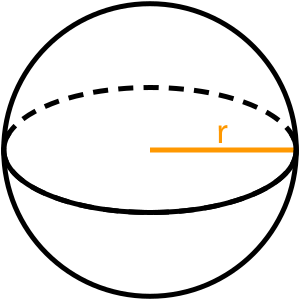



Table of Contents
Sphere definition
A sphere is a perfectly round three-dimensional shape, like a ball. Every point on its surface is the same distance from a single point inside it, the centre. It is what a circle is in two dimensions.
A sphere has the following properties:
- One curved surface, with no faces, edges or vertices
- Every line from the centre to the surface has the same length, the radius
- Every slice through a sphere is a circle, and every slice through its centre is a great circle, the largest circle on it
- It looks the same from every direction
Of all shapes with the same surface area, the sphere holds the most volume. That is why soap bubbles and water drops pull themselves into spheres, and why planets and stars are almost round.
Parts of a sphere
The three parts of a sphere mentioned in this tool are the radius (r), area (A) and volume (V). Any one of them gives the other two.
Radius (r)
The radius of a sphere is the distance from its centre to any point on its surface. Twice the radius is the diameter, the longest straight line through the sphere.
It can be found with the following formulas:
-
If you know the surface area:
r = √(A / (4 * π)) -
If you know the volume:
r = ³√(3 * V / (4 * π))
Area (A)
The area (surface area) of a sphere is the area of its round surface. It is exactly four times the area of a great circle:
A = 4 * π * r²
Volume (V)
The volume of a sphere is the amount of space inside it:
V = 4 * π * r³ / 3
Archimedes, who found both formulas, showed that a sphere fills exactly two thirds of the smallest cylinder it fits in, and has two thirds of that cylinder's surface area too. He considered it his greatest discovery.
Parts cut from a sphere
Cutting a sphere gives shapes that have their own calculators:
- Hemisphere: half a sphere, cut through its centre, with a volume of
2 * π * r³ / 3. - Spherical cap: the part cut off by one plane, like a dome.
- Spherical segment: the slice between two parallel planes.
- Spherical sector: a cap together with the cone that joins it to the centre.
- Spherical wedge: the part between two half-planes through the axis, like a segment of an orange.
Frequently asked questions
How do you find the volume of a sphere?
Cube the radius, multiply by π and by 4, and divide by 3: V = 4 * π * r³ / 3. A ball with r = 10 cm holds 4 × π × 10³ / 3 ≈ 4188.79 cm³, or about 4.19 litres.
How do you find the surface area of a sphere?
Multiply the square of the radius by 4 * π: A = 4 * π * r². For r = 10, that is 4 × π × 10² ≈ 1256.64 square units.
How do you find the radius of a sphere from its volume?
Use r = ³√(3 * V / (4 * π)). A sphere that holds 1 litre (1000 cm³) has a radius of ³√(3 × 1000 / (4 × π)) ≈ 6.20 cm.
What happens to the volume when the radius doubles?
The volume grows with the cube of the radius, so doubling the radius makes the sphere hold 8 times as much, while its surface area grows 4 times.