 CalcKit
Spherical Wedge Calculator
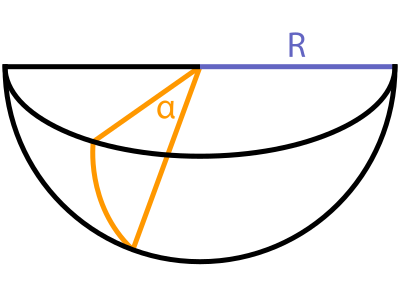




Table of Contents
- Spherical wedge definition
- Parts of a spherical wedge
- Spherical wedge and spherical lune
- Frequently asked questions
Spherical wedge definition
A spherical wedge (also called an ungula) is the part of a sphere cut out by two flat half-planes that meet along a diameter. It looks like a segment of an orange, or a slice of a round cake cut from the top all the way down.
A spherical wedge has the following properties:
- Two flat faces, each a half-disc with the radius of the sphere
- One curved face, the spherical lune, which is part of the sphere's surface
- Its size is set by the radius of the sphere and the angle between the two flat faces
- Every measurement is the same fraction of the whole sphere as its angle is of 360°: a 90° wedge is a quarter of the sphere
When the angle is 180°, the wedge is a hemisphere, and at 360° it is the whole sphere.
Parts of a spherical wedge
The five parts of a spherical wedge mentioned in this tool are the radius (R), angle (α), lateral area (Al), total area (A) and volume (V). In this tool the angle is in degrees.
Radius (R)
The radius of a spherical wedge is the radius of the sphere it was cut from, which is also the radius of its two flat half-discs.
It can be found with the following formulas:
-
If you know the lateral area and the angle:
R = √(90 * Al / (π * α)) -
If you know the volume and the angle:
R = ³√(270 * V / (π * α))
Angle (α)
The angle of a spherical wedge is the angle between its two flat faces, measured in degrees.
It can be found with the following formulas:
-
If you know the lateral area and the radius:
α = 90 * Al / (π * R²) -
If you know the volume and the radius:
α = 270 * V / (π * R³)
Lateral area (Al)
The lateral area of a spherical wedge is the area of its curved face only, the lune. It is the fraction α / 360° of the sphere's surface, 4 * π * R².
It can be found with the following formulas:
-
If you know the radius and the angle:
Al = π * R² * α / 90 -
If you know the total area and the radius:
Al = A - π * R²
Total area (A)
The total area of a spherical wedge is its curved face plus its two flat half-discs, which together have the area of one full circle, π * R²:
A = Al + π * R²
Volume (V)
The volume of a spherical wedge is the amount of space inside it. It is the fraction α / 360° of the sphere's volume, 4 * π * R³ / 3:
V = π * R³ * α / 270
Spherical wedge and spherical lune
The two names describe related things:
- Spherical wedge: the solid piece of the sphere, with its two flat faces and its curved face.
- Spherical lune: only the curved surface of the wedge, the part of the sphere's surface between two great half-circles. Its area is the lateral area above. The name comes from the Latin for moon, after its crescent shape.
On the Earth, the area between two lines of longitude, from pole to pole, is a spherical lune. A 15° lune, the width of one hour of time zones, covers 1/24 of the Earth's surface.
Frequently asked questions
How do you find the volume of a spherical wedge?
Take the fraction α / 360° of the sphere's volume: V = π * R³ * α / 270. A wedge with α = 60° and R = 6 holds π × 6³ × 60 / 270 ≈ 150.80 cubic units, one sixth of the sphere.
How do you find the surface area of a spherical wedge?
Add the curved lune, π * R² * α / 90, and the two half-discs, π * R². For α = 60° and R = 6, that is π × 6² × 60 / 90 + π × 6² ≈ 188.50 square units.
What is the difference between a spherical wedge and a spherical sector?
A spherical wedge is cut by two planes through a diameter, like an orange segment, and runs from pole to pole. A spherical sector is a cap and a cone meeting at the centre, like an ice cream cone.
Why is the angle divided by 270 in the volume formula?
The sphere's volume, 4 * π * R³ / 3, multiplied by α / 360 gives 4 * π * R³ * α / 1080, which simplifies to π * R³ * α / 270.