 CalcKit
Spherical Segment Calculator
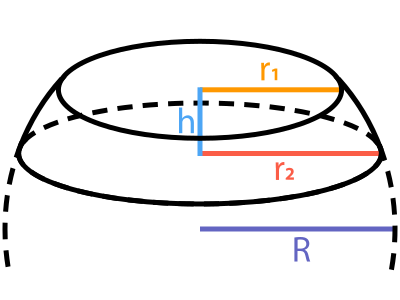



Table of Contents
- Spherical segment definition
- Parts of a spherical segment
- Spherical segment, cap and zone
- Frequently asked questions
Spherical segment definition
A spherical segment is the part of a sphere that lies between two parallel planes, like a slice cut from a ball. It is sometimes called a spherical frustum.
A spherical segment has two flat circular bases, one on each cutting plane, and a curved band of the sphere's surface between them. The two bases usually have different radii, unless the planes are the same distance from the centre on opposite sides.
When one of the two planes only touches the sphere, its base shrinks to a single point and the segment becomes a spherical cap.
Parts of a spherical segment
The seven parts of a spherical segment mentioned in this tool are the top base radius (r1), bottom base radius (r2), radius of the sphere (R), height (h), lateral area (Al), total area (A) and volume (V).
Top base radius (r1)
The top base radius is the radius of the circular base on one of the two cutting planes.
It can be found with the following formulas:
-
If you know the total area, the lateral area and the other base radius:
r1 = √((A - Al - π * r2²) / π) -
If you know the volume, the height and the other base radius:
r1 = √((6 * V / (π * h) - h²) / 3 - r2²)
Bottom base radius (r2)
The bottom base radius is the radius of the circular base on the other cutting plane.
It can be found with the following formulas:
-
If you know the total area, the lateral area and the other base radius:
r2 = √((A - Al - π * r1²) / π) -
If you know the volume, the height and the other base radius:
r2 = √((6 * V / (π * h) - h²) / 3 - r1²)
Radius of sphere (R)
The radius of the sphere is the radius of the whole ball the segment was cut from.
If you know the lateral area and the height:
R = Al / (2 * π * h)
Height (h)
The height of a spherical segment is the distance between its two parallel bases.
If you know the lateral area and the radius of the sphere:
h = Al / (2 * π * R)
Lateral area (Al)
The lateral area of a spherical segment is the area of its curved band only, without the two flat bases. This curved band is called a spherical zone.
It can be found with the following formulas:
-
If you know the radius of the sphere and the height:
Al = 2 * π * R * h -
If you know the total area and both base radii:
Al = A - (π * r1²) - (π * r2²)
A remarkable property: the area of the zone depends only on the height and the sphere's radius, not on where the slice is taken. A slice of the same thickness near the top of a ball has the same curved area as one through the middle.
Total area (A)
The total area of a spherical segment is its curved band plus its two flat bases:
A = Al + (π * r1²) + (π * r2²)
Volume (V)
The volume of a spherical segment is the amount of space between its two bases.
If you know both base radii and the height:
V = π * h * ((3 * r1²) + (3 * r2²) + h²) / 6
Spherical segment, cap and zone
These related terms are easy to confuse:
-
Spherical segment: the solid part of a sphere between two parallel planes, with two flat bases.
-
Spherical zone: only the curved surface of a spherical segment, without its bases. Its area is
2 * π * R * h. -
Spherical cap: a spherical segment with only one base, cut off by a single plane.
-
Spherical sector: a cap together with the cone that joins it to the centre of the sphere.
Frequently asked questions
How do you find the volume of a spherical segment?
Use V = π * h * ((3 * r1²) + (3 * r2²) + h²) / 6 with the two base radii and the height. For r1 = 3, r2 = 4 and h = 1, that is π × 1 × (3 × 3² + 3 × 4² + 1²) / 6 ≈ 39.79 cubic units.
How do you find the radius of the sphere from a spherical segment?
From the lateral area: R = Al / (2 * π * h). From the base radii and the height instead, first find the distance from the centre to the bottom base, d = (r2² - r1² - h²) / (2 * h), then R = √(r2² + d²).
What is the difference between a spherical segment and a spherical cap?
A spherical segment is cut by two parallel planes and has two flat bases. A spherical cap is cut by one plane and has only one base, so it is a segment whose top base has become a point.