 CalcKit
Spherical Sector Calculator
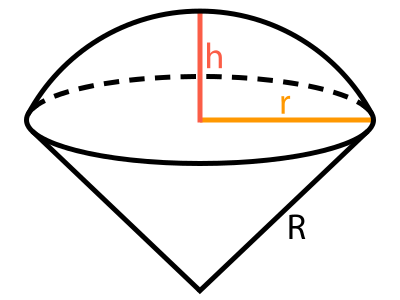




Table of Contents
- Spherical sector definition
- Parts of a spherical sector
- Spherical sector, cap and segment
- Frequently asked questions
Spherical sector definition
A spherical sector is the part of a sphere made of a spherical cap and the cone that joins the base of that cap to the centre of the sphere. It is also called a spherical cone.
It looks like a scoop of ice cream sitting on its cone, where the tip of the cone is the centre of the ball. In three dimensions it is what a slice of pie, a circular sector, is in two.
A spherical sector has two surfaces: the curved surface of the cap, which is part of the sphere, and the curved surface of the cone. When the cap is a hemisphere, the cone flattens into a disc and the sector is exactly half the sphere.
Parts of a spherical sector
The five parts of a spherical sector mentioned in this tool are the height of the cap (h), the radius of the cap (r), the radius of the sphere (R), the area (A) and the volume (V).
Height of spherical cap (h)
The height of the spherical cap is the distance from the centre of the cap's base to the top of its dome.
It can be found with the following formulas:
-
If you know the area, the radius of the sphere and the radius of the cap:
h = (A / (π * R) - r) / 2 -
If you know the volume and the radius of the sphere:
h = 3 * V / (2 * π * R²)
Radius of spherical cap (r)
The radius of the spherical cap is the radius of the circle where the cap meets the cone.
If you know the height of the cap and the radius of the sphere:
r = √(h * (2 * R - h))
Radius of sphere (R)
The radius of the sphere is the radius of the whole ball the sector was cut from. It is also the slant height of the cone part of the sector.
It can be found with the following formulas:
-
If you know the radius and the height of the cap:
R = (r² + h²) / (2 * h) -
If you know the volume and the height of the cap:
R = √(3 * V / (2 * π * h))
Area (A)
The area (total surface area) of a spherical sector is the area of the curved cap, 2 * π * R * h, plus the curved surface of the cone, π * r * R:
A = π * R * (2 * h + r)
Volume (V)
The volume of a spherical sector is the amount of space inside it:
V = 2 * π * R² * h / 3
It depends only on the radius of the sphere and the height of the cap. A full sphere is the case h = 2R, which gives the sphere's own 4 * π * R³ / 3.
Spherical sector, cap and segment
Three shapes are cut from a sphere, and they are easy to mix up:
-
Spherical sector: a cap together with the cone that joins it to the centre of the sphere, like an ice cream cone.
-
Spherical cap: the part of a sphere cut off by one plane, with a flat circular base. The sector's volume is the cap's volume plus the cone's.
-
Spherical segment: the part of a sphere between two parallel planes, with two flat bases.
Frequently asked questions
How do you find the volume of a spherical sector?
Use V = 2 * π * R² * h / 3, with the radius of the sphere and the height of the cap. For R = 5 and h = 2, that is 2 × π × 5² × 2 / 3 ≈ 104.72 cubic units.
How do you find the surface area of a spherical sector?
Add the area of the cap and the area of the cone: A = π * R * (2 * h + r). For R = 5 and h = 2, the cap radius is r = 4, and the area is π × 5 × (2 × 2 + 4) ≈ 125.66 square units.
What is the difference between a spherical sector and a spherical cap?
A spherical cap is cut off by a plane and has a flat base. A spherical sector adds a cone to that cap, reaching down to the centre of the sphere, so it has a point instead of a flat base.
Is a hemisphere a spherical sector?
Yes. When the height of the cap equals the radius of the sphere, the cone becomes a flat disc and the spherical sector is a hemisphere, with a volume of 2 * π * R³ / 3.