 CalcKit
Tetrahedron Calculator
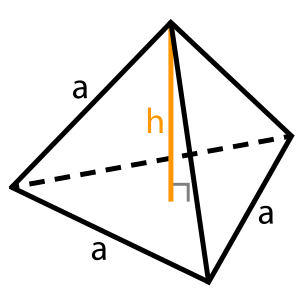
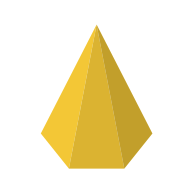
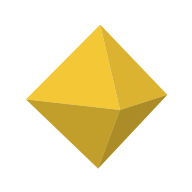


Table of Contents
Tetrahedron definition
A tetrahedron is a three-dimensional shape with four triangular faces, six edges and four vertices. Its name comes from Greek and means "four faces".
This tool works with the regular tetrahedron, whose four faces are identical equilateral triangles. All its edges have the same length, and three faces meet at every vertex.
A regular tetrahedron has the following properties:
- 4 faces, all equilateral triangles
- 6 edges of equal length
- 4 vertices
- The angle between any two faces (the dihedral angle) is about 70.53°
The regular tetrahedron is the simplest of the five Platonic solids, together with the cube, the octahedron, the dodecahedron and the icosahedron. It is also a triangular pyramid whose side faces are the same as its base, so it can stand on any of its faces and look the same.
Parts of a tetrahedron
The six parts of a tetrahedron mentioned in this tool are the side (a), height (h), area (A), volume (V), inradius (r) and circumradius (R).
Side (a)
The side (or edge length) of a regular tetrahedron is the length of any of its six edges.
It can be found with the following formulas:
-
If you know the height:
a = h / √(2/3) -
If you know the surface area:
a = √(A / √3) -
If you know the volume:
a = ³√(6 * √2 * V) -
If you know the inradius:
a = 2 * √6 * r -
If you know the circumradius:
a = 2 * √(2/3) * R
Height (h)
The height of a tetrahedron is the perpendicular distance from one vertex down to the opposite face.
It can be found with the following formulas:
-
If you know the side:
h = √(2/3) * a -
If you know the inradius and the circumradius:
h = r + R
Area (A)
The area (total surface area) of a regular tetrahedron is the combined area of its four equilateral triangles. Each face has an area of √3 * a² / 4, so:
A = √3 * a²
Volume (V)
The volume of a regular tetrahedron is the amount of space inside it:
V = a³ / (6 * √2)
This is exactly one third of the base area times the height, as for every pyramid.
Inradius (r)
The inradius of a tetrahedron is the radius of the largest sphere that fits inside it, touching all four faces.
It can be found with the following formulas:
-
If you know the side:
r = a * √6 / 12 -
If you know the height and the circumradius:
r = h - R
Circumradius (R)
The circumradius of a tetrahedron is the radius of the sphere that passes through all four of its vertices.
It can be found with the following formulas:
-
If you know the side:
R = a * √6 / 4 -
If you know the height and the inradius:
R = h - r
The circumradius is always three times the inradius, so the centre of a tetrahedron lies a quarter of the way up its height.
The Platonic solids
A Platonic solid is a convex shape whose faces are all the same regular polygon, with the same number of faces meeting at every vertex. There are only five:
- Tetrahedron: 4 triangular faces
- Cube: 6 square faces
- Octahedron: 8 triangular faces
- Dodecahedron: 12 pentagonal faces
- Icosahedron: 20 triangular faces
The tetrahedron is the only one of the five with no parallel faces. Its shape appears in chemistry, where the four bonds of a carbon atom in methane point to the corners of a tetrahedron, and in the classic four-sided die (d4) used in tabletop games.
Frequently asked questions
How do you find the volume of a tetrahedron?
For a regular tetrahedron, cube the side length and divide by 6 * √2: V = a³ / (6 * √2). For a = 6, that is 6³ / (6 × √2) ≈ 25.46 cubic units.
How do you find the surface area of a tetrahedron?
Multiply the square of the side by √3: A = √3 * a². For a = 6, that is √3 × 6² ≈ 62.35 square units.
How do you find the height of a tetrahedron?
Multiply the side by √(2/3): h = √(2/3) * a, which is about 0.8165 × a.
Is a tetrahedron a pyramid?
Yes. A tetrahedron is a pyramid with a triangular base. In a regular tetrahedron the base and the three side faces are identical equilateral triangles, so any face can serve as the base.