 CalcKit
Pyramidal Frustum Calculator
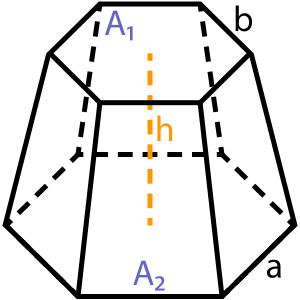



Table of Contents
Pyramidal frustum definition
A pyramidal frustum, or truncated pyramid, is what is left of a pyramid when its top is cut off by a plane parallel to its base. It has two parallel bases of the same shape, a larger one at the bottom and a smaller one on top, joined by trapezoid faces.
This calculator is for a regular pyramid's frustum, whose bases are regular polygons: equilateral triangles, squares, regular pentagons and so on. Enter the number of sides first.
Parts of a pyramidal frustum
There are eight parts of a pyramidal frustum mentioned in this tool: number of sides, bottom base length (a), top base length (b), height (h), top area (A1), bottom area (A2), area (A) and volume (V).
Number of sides (n)
A pyramidal frustum has the same number of sides as the original pyramid. For example, if the original pyramid is a square pyramid, the frustum will also have four sides. If the original pyramid is a triangular pyramid, the frustum will have three sides.
Bottom base length (a)
The bottom base length, or "a", refers to the length of the bottom base of the pyramidal frustum. This is the length of one of the sides of the bottom base.
We can calculate the bottom base length with the following formula:
a = √(A2 * 4 * tan(180/n) / n)
Top base length (b)
The top base length, or "b", refers to the length of the top base of the pyramidal frustum. This is the length of one of the sides of the top base.
We can find the top base length by using a similar formula, only replacing the bottom area (A2) with the top area (A1):
b = √(A1 * 4 * tan(180/n) / n)
Height (h)
The height, or "h", refers to the distance between the top base and bottom base of the pyramidal frustum. It can be calculated with the following formula:
h = 3 * V / (A1 + A2 + √(A1*A2))
Top area (A1)
The top area, or "A1", refers to the surface area of the top base of the pyramidal frustum. The formula for calculating the top area of a pyramidal frustum is:
A1 = b² * n / (4 * tan(180/n))
Bottom area (A2)
The bottom area, or "A2", refers to the surface area of the bottom base of the pyramidal frustum. The formula for calculating the bottom area of a pyramidal frustum is:
A2 = a² * n / (4 * tan(180/n))
Area (A)
The area, or "A", refers to the total surface area of the pyramidal frustum.
To calculate the total area we first calculate the lateral area (A3) of the pyramidal frustum:
A3 = n * (a + b) / 2 * √((h² + (a / (2 * sin(180/n)) - b / (2 * sin(180/n)))²) - ((a - b) / 2)²)
then, we add all three areas together:
A = A1 + A2 + A3
Volume (V)
The volume, or "V", refers to the amount of space inside the pyramidal frustum. The formula for calculating the volume of a pyramidal frustum is:
V = h / 3 * (A1 + A2 + √(A1*A2))
Example
A square frustum (4 sides) with a bottom base of 6, a top base of 4 and a height of 3:
-
Bottom and top areas: for a square, the side squared.
A2 = 6² = 36andA1 = 4² = 16 -
Volume:
V = 3 / 3 * (16 + 36 + √(16 * 36)) = 16 + 36 + 24 = 76 -
Total surface area: both bases plus the four trapezoid faces.
A = 115.2
Frequently asked questions
How do you find the volume of a rectangular frustum?
A frustum with rectangular bases, cut from a rectangular pyramid, isn't regular, so it needs its own formula. With the bottom base a1 × b1, the top base a2 × b2 and the height h:
V = h / 6 * ((2 * a1 + a2) * b1 + (a1 + 2 * a2) * b2)
For a bottom of 6 × 4, a top of 3 × 2 and a height of 5: 5 / 6 * (15 * 4 + 12 * 2) = 70.
Is the volume of a frustum the average of the two bases times the height?
No, that overestimates it. The formula V = h / 3 * (A1 + A2 + √(A1 * A2)) adds the geometric mean of the two areas instead. For the example above, the average would give (16 + 36) / 2 * 3 = 78, against the true 76.
How do you find the height of a frustum?
From the volume and the two base areas: h = 3 * V / (A1 + A2 + √(A1 * A2)).