 CalcKit
Torus Calculator
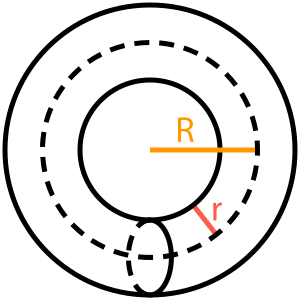


Table of Contents
Torus definition
A torus is a ring-shaped three-dimensional surface, like a doughnut or an inflated inner tube. It is made by spinning a circle around a straight line in the same plane that does not cross it.
A torus is described by two radii: the radius of the tube itself, and the distance from the centre of the hole to the centre of the tube.
A torus has the following properties:
- One curved surface, with no faces, edges or vertices
- A hole through its middle, as long as the tube is narrower than the distance to the centre
- Every slice through its axis shows two identical circles, the cross-sections of the tube
Tori are everywhere: doughnuts, bagels, rings, O-ring seals, lifebuoys, tyre inner tubes and the magnetic chambers of fusion reactors.
Parts of a torus
The four parts of a torus mentioned in this tool are the minor radius (r), major radius (R), area (A) and volume (V).
Minor radius (r)
The minor radius is the radius of the tube, the circle that is spun to make the torus.
It can be found with the following formulas:
-
If you know the surface area and the major radius:
r = A / (4 * π² * R) -
If you know the volume and the major radius:
r = √(V / (2 * π² * R))
Major radius (R)
The major radius is the distance from the centre of the torus, in the middle of the hole, to the centre of the tube.
It can be found with the following formulas:
-
If you know the surface area and the minor radius:
R = A / (4 * π² * r) -
If you know the volume and the minor radius:
R = V / (2 * π² * r²)
Area (A)
The area (surface area) of a torus is the area of its curved surface. It is the circumference of the tube times the length of the circle its centre travels around:
A = 2 * π * r * 2 * π * R = 4 * π² * R * r
Volume (V)
The volume of a torus is the amount of space inside the tube. It is the area of the tube's circle times the length of the path its centre travels:
V = π * r² * 2 * π * R = 2 * π² * R * r²
Both formulas follow from Pappus's centroid theorem: a shape spun around an axis sweeps a volume equal to its area times the distance its centre travels.
Inner and outer radius
A torus is often measured from the outside instead, by the radius of its hole and its total radius:
- Inner radius: from the centre to the inside edge of the ring,
R - r. - Outer radius: from the centre to the outside edge of the ring,
R + r.
To use those measurements in this tool, convert them first: the major radius is the average of the two, R = (outer + inner) / 2, and the minor radius is half their difference, r = (outer - inner) / 2.
When R is larger than r, the torus is a ring torus with a hole. When R equals r, the hole closes to a single point (a horn torus), and when R is smaller than r, the tube overlaps itself (a spindle torus).
Frequently asked questions
How do you find the volume of a torus?
Multiply the area of the tube's circle by the distance its centre travels: V = 2 * π² * R * r². A doughnut with R = 5 cm and r = 2 cm has a volume of 2 × π² × 5 × 2² ≈ 394.78 cm³.
How do you find the surface area of a torus?
Multiply the two circumferences: A = 4 * π² * R * r. For R = 5 and r = 2, that is 4 × π² × 5 × 2 ≈ 394.78 square units, the same number as the volume, since r = 2.
What is the difference between the major and the minor radius?
The minor radius is the radius of the tube, from its centre to its surface, so the ring is 2r thick. The major radius is the distance from the centre of the hole to the centre of the tube.
Is a doughnut a torus?
Yes, a ring doughnut is a classic example of a solid torus. In mathematics, a torus usually means only the surface, while the solid shape inside it is called a solid torus.