 CalcKit
Icosahedron Calculator
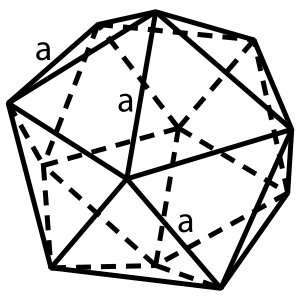



Table of Contents
Icosahedron definition
An icosahedron is a three-dimensional shape with twenty faces. Its name comes from Greek and means "twenty faces".
This tool works with the regular icosahedron, whose twenty faces are identical equilateral triangles.
A regular icosahedron has the following properties:
- 20 faces, all equilateral triangles
- 30 edges of equal length
- 12 vertices, with five faces meeting at each one
- The angle between two adjacent faces (the dihedral angle) is about 138.19°
The regular icosahedron is one of the five Platonic solids, and the one with the most faces. For a given surface area it holds the most volume of the five, which makes it the closest of them to a sphere. It is the dual of the dodecahedron.
Parts of an icosahedron
The five parts of an icosahedron mentioned in this tool are the side (a), area (A), volume (V), inradius (r) and circumradius (R).
Side (a)
The side (or edge length) of a regular icosahedron is the length of any of its thirty edges.
It can be found with the following formulas:
-
If you know the surface area:
a = √(A / (5 * √3)) -
If you know the volume:
a = ³√(12 * V / (5 * (3 + √5))) -
If you know the inradius:
a = 12 * r / (3 * √3 + √15) -
If you know the circumradius:
a = 4 * R / √(10 + 2 * √5)
Area (A)
The area (total surface area) of a regular icosahedron is the combined area of its twenty equilateral triangles. Each face has an area of √3 * a² / 4, so:
A = 5 * √3 * a²
Volume (V)
The volume of a regular icosahedron is the amount of space inside it:
V = 5 * (3 + √5) * a³ / 12
That is about 2.18 times the cube of the side.
Inradius (r)
The inradius of an icosahedron is the radius of the largest sphere that fits inside it, touching the centre of each of its twenty faces:
r = (3 * √3 + √15) * a / 12
Circumradius (R)
The circumradius of an icosahedron is the radius of the sphere that passes through all twelve of its vertices:
R = √(10 + 2 * √5) * a / 4
The Platonic solids
A Platonic solid is a convex shape whose faces are all the same regular polygon, with the same number of faces meeting at every vertex. There are only five:
- Tetrahedron: 4 triangular faces
- Cube: 6 square faces
- Octahedron: 8 triangular faces
- Dodecahedron: 12 pentagonal faces
- Icosahedron: 20 triangular faces
Icosahedrons are found in the shells of many viruses, in geodesic domes, which start from an icosahedron and divide its faces further, and in the twenty-sided die (d20) used in tabletop games.
Frequently asked questions
How do you find the volume of an icosahedron?
For a regular icosahedron, use V = 5 * (3 + √5) * a³ / 12, or about 2.1817 × a³. For a = 2, that is 2.1817 × 2³ ≈ 17.45 cubic units.
How do you find the surface area of an icosahedron?
Multiply the square of the side by 5 * √3: A = 5 * √3 * a². For a = 2, that is 5 × √3 × 2² ≈ 34.64 square units.
How many faces, edges and vertices does an icosahedron have?
20 faces, 30 edges and 12 vertices. Like every convex polyhedron, it follows Euler's formula: 12 - 30 + 20 = 2.
What is the difference between an icosahedron and a dodecahedron?
An icosahedron has 20 triangular faces and 12 vertices, while a dodecahedron has 12 pentagonal faces and 20 vertices. They are duals of each other, with the numbers of faces and vertices swapped.