 CalcKit
Dodecahedron Calculator
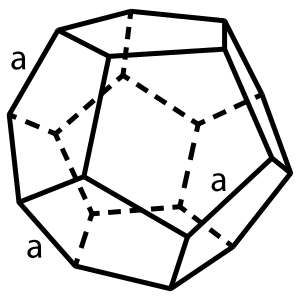
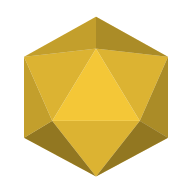
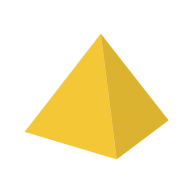
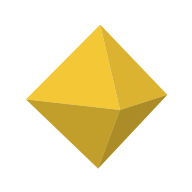

Table of Contents
Dodecahedron definition
A dodecahedron is a three-dimensional shape with twelve faces. Its name comes from Greek and means "twelve faces".
This tool works with the regular dodecahedron, whose twelve faces are identical regular pentagons.
A regular dodecahedron has the following properties:
- 12 faces, all regular pentagons
- 30 edges of equal length
- 20 vertices, with three faces meeting at each one
- The angle between two adjacent faces (the dihedral angle) is about 116.57°
The regular dodecahedron is one of the five Platonic solids, and the only one with pentagonal faces. It is the dual of the icosahedron: joining the centres of the faces of one gives the other. Many of its measurements involve √5, because the regular pentagon is built on the golden ratio, φ = (1 + √5) / 2 ≈ 1.618.
Parts of a dodecahedron
The five parts of a dodecahedron mentioned in this tool are the side (a), area (A), volume (V), inradius (r) and circumradius (R).
Side (a)
The side (or edge length) of a regular dodecahedron is the length of any of its thirty edges.
It can be found with the following formulas:
-
If you know the surface area:
a = √(A / (3 * √(25 + 10 * √5))) -
If you know the volume:
a = ³√(4 * V / (15 + 7 * √5)) -
If you know the inradius:
a = √(50 - 22 * √5) * r -
If you know the circumradius:
a = 4 * R / (√3 + √15)
Area (A)
The area (total surface area) of a regular dodecahedron is the combined area of its twelve pentagons:
A = 3 * √(25 + 10 * √5) * a²
That is about 20.65 times the square of the side.
Volume (V)
The volume of a regular dodecahedron is the amount of space inside it:
V = (15 + 7 * √5) * a³ / 4
That is about 7.66 times the cube of the side.
Inradius (r)
The inradius of a dodecahedron is the radius of the largest sphere that fits inside it, touching the centre of each of its twelve faces:
r = √(250 + 110 * √5) * a / 20
Circumradius (R)
The circumradius of a dodecahedron is the radius of the sphere that passes through all twenty of its vertices:
R = (√3 + √15) * a / 4
The Platonic solids
A Platonic solid is a convex shape whose faces are all the same regular polygon, with the same number of faces meeting at every vertex. There are only five:
- Tetrahedron: 4 triangular faces
- Cube: 6 square faces
- Octahedron: 8 triangular faces
- Dodecahedron: 12 pentagonal faces
- Icosahedron: 20 triangular faces
The ancient Greeks linked the dodecahedron with the heavens. Today it is best known as the twelve-sided die (d12) used in tabletop games, and as the shape of some calendars, with one month on each face.
Frequently asked questions
How do you find the volume of a dodecahedron?
For a regular dodecahedron, use V = (15 + 7 * √5) * a³ / 4, or about 7.663 × a³. For a = 2, that is 7.663 × 2³ ≈ 61.30 cubic units.
How do you find the surface area of a dodecahedron?
Use A = 3 * √(25 + 10 * √5) * a², or about 20.646 × a². For a = 2, that is 20.646 × 2² ≈ 82.58 square units.
How many faces, edges and vertices does a dodecahedron have?
12 faces, 30 edges and 20 vertices. Like every convex polyhedron, it follows Euler's formula: 20 - 30 + 12 = 2.
What is the difference between a dodecahedron and an icosahedron?
A dodecahedron has 12 pentagonal faces and 20 vertices, while an icosahedron has 20 triangular faces and 12 vertices. They are duals of each other, with the numbers of faces and vertices swapped.