 CalcKit
Rhombus Calculator
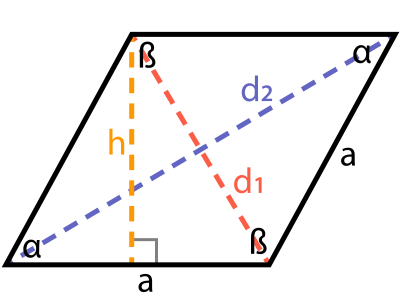




Table of Contents
Rhombus definition
A rhombus is a quadrilateral with four sides of equal length. It is sometimes called a diamond, because of the shape it has when it stands on one of its corners.
A rhombus is a special kind of parallelogram: its opposite sides are parallel and its opposite angles are equal. What makes it special is that all four sides are the same length.
For every rhombus, the following properties apply:
- All four sides are equal in length.
- Opposite sides are parallel.
- Opposite angles are equal, and two neighbouring angles always add up to 180°.
- The diagonals cross each other at a right angle (90°) and cut each other in half.
- Each diagonal divides the rhombus into two congruent isosceles triangles.
Parts of a rhombus
The nine parts of a rhombus mentioned in this tool are side length (a), shorter diagonal (d1), longer diagonal (d2), height (h), area (A), perimeter (P), smaller angle (α), larger angle (β) and inradius (r).
Side length (a)
The side length of a rhombus is the length of any one of its four sides. Since all sides are equal, one value describes them all.
It can be found with the following formulas:
-
If you know the perimeter:
a = P / 4 -
If you know the area and the height:
a = A / h -
If you know the height and the smaller angle:
a = h / sin(α) -
If you know the area and the smaller angle:
a = √(A / sin(α)) -
If you know both diagonals and the height:
a = d1 * d2 / (2 * h) -
If you know the inradius and the smaller angle:
a = 2 * r / sin(α)
Shorter diagonal (d1)
The shorter diagonal of a rhombus is the shorter of the two line segments that join opposite corners. It joins the two corners with the larger angle.
It can be found with the following formulas:
-
If you know the side length and the longer diagonal:
d1 = √(4 * a² - d2²) -
If you know the side length and the smaller angle:
d1 = √(2 * a² - 2 * a² * cos(α)) -
If you know the area and the longer diagonal:
d1 = 2 * A / d2
Longer diagonal (d2)
The longer diagonal of a rhombus is the longer of the two line segments that join opposite corners. It joins the two corners with the smaller angle.
It can be found with the following formulas:
-
If you know the side length and the shorter diagonal:
d2 = √(4 * a² - d1²) -
If you know the area and the shorter diagonal:
d2 = 2 * A / d1
Height (h)
The height of a rhombus is the perpendicular distance between two opposite sides.
It can be found with the following formulas:
-
If you know the area and the side length:
h = A / a -
If you know the side length and one of the angles:
h = a * sin(α) = a * sin(β) -
If you know the inradius:
h = 2 * r
Area (A)
The area of a rhombus is the amount of space enclosed by its four sides.
It can be found with the following formulas:
-
If you know the side length and the height:
A = a * h -
If you know both diagonals:
A = d1 * d2 / 2
Perimeter (P)
The perimeter of a rhombus is the total length of its boundary. Since all four sides are equal, it is simply four times the side length:
P = 4 * a
Smaller angle (α)
The smaller angle of a rhombus is the acute interior angle, found at the two corners joined by the longer diagonal.
It can be found with the following formulas:
-
If you know the larger angle:
α = 180° - β -
If you know the height and the side length:
α = arcsin(h / a)
Larger angle (β)
The larger angle of a rhombus is the obtuse interior angle, found at the two corners joined by the shorter diagonal. When both angles are 90°, the rhombus is a square.
Since neighbouring angles add up to 180°:
β = 180° - α
Inradius (r)
The inradius of a rhombus is the radius of the largest circle that fits inside it, touching all four sides. Every rhombus has such a circle, centred where the diagonals cross.
The inradius is half the height:
r = h / 2
Rhombus, square and parallelogram
A rhombus sits between two other familiar shapes:
-
Every square is a rhombus. A square is a rhombus whose angles are all 90°, which also makes its two diagonals equal in length.
-
Every rhombus is a parallelogram. A parallelogram only needs its opposite sides to be equal and parallel; a rhombus needs all four sides equal.
-
A rhombus is not usually a rectangle. A rectangle has four right angles but sides of two different lengths. The only shape that is both a rhombus and a rectangle is a square.
Frequently asked questions
How do you find the area of a rhombus?
Multiply the two diagonals and divide by two: A = d1 * d2 / 2. If you know the side length and the height instead, multiply them: A = a * h.
How do you find the side of a rhombus from its diagonals?
The diagonals cut each other in half at a right angle, so each side is the hypotenuse of a right triangle with legs d1 / 2 and d2 / 2: a = √(d1² + d2²) / 2.
Are the diagonals of a rhombus equal?
Only when the rhombus is a square. In any other rhombus one diagonal is shorter than the other, but they always cross at a right angle.
Is a rhombus a square?
Not always. A square is a rhombus with four right angles, but a rhombus can have any pair of angles that add up to 180°, such as 60° and 120°.