 CalcKit
Right Triangle Calculator
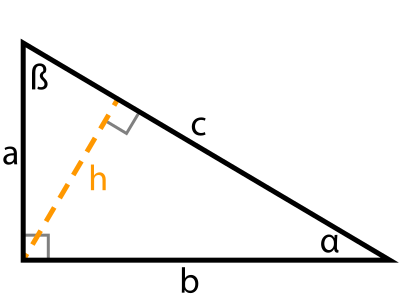



Table of Contents
- Right triangle definition
- The Pythagorean theorem
- Parts of a right triangle
- Segments of the hypotenuse (k and m)
- Frequently asked questions
Right triangle definition
A right triangle (or right-angled triangle) is a triangle in which one of the three angles is exactly 90°, a right angle.
The two sides that form the right angle are called the legs (or catheti), and the side opposite the right angle is the hypotenuse, always the longest side of the triangle. The other two angles are acute and always add up to 90°.
Right triangles are the basis of trigonometry: the sine, cosine and tangent of an angle are defined as ratios of the sides of a right triangle. They are used every day in construction, navigation, engineering and physics.
The Pythagorean theorem
The best-known rule about right triangles is the Pythagorean theorem: the square of the hypotenuse (c) equals the sum of the squares of the two legs (a and b).
c² = a² + b²
It lets you find any side of a right triangle from the other two. The most famous example is the 3-4-5 triangle: with legs of 3 and 4, the hypotenuse is √(3² + 4²) = 5. Sets of three whole numbers like this, such as 5-12-13 and 8-15-17, are called Pythagorean triples.
Parts of a right triangle
The ten parts of a right triangle mentioned in this tool are the shorter leg (a), longer leg (b), hypotenuse (c), height on the hypotenuse (h), area (A), perimeter (P), smaller angle (α), larger angle (β), inradius (r) and circumradius (R). Two more, the segments of the hypotenuse (k and m), are calculated in the background as a middle step (see below).
In this tool, α is the angle opposite the shorter leg a, and β the angle opposite the longer leg b.
Shorter leg (a)
The shorter leg is the shorter of the two sides that form the right angle. It lies opposite the smaller angle α.
It can be found with the following formulas:
-
If you know the hypotenuse and the other leg (Pythagorean theorem):
a = √(c² - b²) -
If you know the area and the other leg:
a = 2 * A / b -
If you know the hypotenuse and an angle:
a = c * sin(α) = c * cos(β) -
If you know the other leg and an angle:
a = b * tan(α)
Longer leg (b)
The longer leg is the longer of the two sides that form the right angle. It lies opposite the larger angle β.
It can be found with the following formulas:
-
If you know the hypotenuse and the other leg:
b = √(c² - a²) -
If you know the area and the other leg:
b = 2 * A / a -
If you know the hypotenuse and an angle:
b = c * cos(α) = c * sin(β) -
If you know the other leg and an angle:
b = a * tan(β)
Hypotenuse (c)
The hypotenuse is the side opposite the right angle, and the longest side of a right triangle.
It can be found with the following formulas:
-
If you know both legs (Pythagorean theorem):
c = √(a² + b²) -
If you know the area and the height:
c = 2 * A / h -
If you know the circumradius:
c = 2 * R -
If you know a leg and an angle:
c = a / sin(α) = b / cos(α)
Height on hypotenuse (h)
The height on the hypotenuse is the perpendicular line from the right angle down to the hypotenuse. It divides the right triangle into two smaller right triangles, both similar to the original one, and it is also the shortest distance from the right angle to the hypotenuse.
It can be found with the following formulas:
-
If you know the area and the hypotenuse:
h = 2 * A / c -
If you know both legs and the hypotenuse:
h = a * b / c -
If you know a leg and an angle:
h = b * sin(α) = a * sin(β)
Area (A)
The area of a right triangle is the space enclosed by its three sides. The two legs act as base and height for each other, so the area is half their product.
It can be found with the following formulas:
-
If you know both legs:
A = a * b / 2 -
If you know the hypotenuse and the height on it:
A = c * h / 2 -
If you know one leg and an angle:
A = b² * tan(α) / 2
Perimeter (P)
The perimeter of a right triangle is the total length of its three sides:
P = a + b + c
Smaller angle (α)
The smaller angle is the acute angle opposite the shorter leg.
It can be found with the following formulas:
-
If you know the other angle:
α = 90° - β -
If you know the shorter leg and the hypotenuse:
α = arcsin(a / c) -
If you know the longer leg and the hypotenuse:
α = arccos(b / c) -
If you know both legs:
α = arctan(a / b)
Larger angle (β)
The larger angle is the acute angle opposite the longer leg.
It can be found with the following formulas:
-
If you know the other angle:
β = 90° - α -
If you know the longer leg and the hypotenuse:
β = arcsin(b / c) -
If you know both legs:
β = arctan(b / a)
Inradius (r)
The inradius of a right triangle is the radius of the largest circle that fits inside it, touching all three sides.
If you know all three sides:
r = a * b / (a + b + c)
Circumradius (R)
The circumradius of a right triangle is the radius of the circle that passes through all three of its corners. In a right triangle, the hypotenuse is always a diameter of that circle (Thales' theorem), so the circumradius is half the hypotenuse:
R = c / 2
Segments of the hypotenuse (k and m)
The height on the hypotenuse divides the hypotenuse into two segments: k, next to the shorter leg a, and m, next to the longer leg b. They are the shadows, or projections, of the two legs on the hypotenuse.
This tool doesn't show them, but it calculates them in the background, because they connect the legs, the height and the hypotenuse to each other. That is what lets it find the rest of the triangle from combinations such as the height and one leg, or the height and the hypotenuse.
The two segments add up to the hypotenuse:
c = k + m
Each segment comes from its leg and the hypotenuse, or from its leg and the height:
k = a² / candm = b² / ck = √(a² - h²)andm = √(b² - h²)
With them, Euclid's theorems give the legs and the height:
a = √(c * k)andb = √(c * m)(the leg rule)h = √(k * m)(the height rule, or geometric mean theorem)
For the 3-4-5 triangle, k = 9 / 5 = 1.8 and m = 16 / 5 = 3.2, which add up to the hypotenuse, 5, and give a height of √(1.8 × 3.2) = 2.4.
Frequently asked questions
How do you find the hypotenuse of a right triangle?
Square both legs, add them, and take the square root: c = √(a² + b²). For a = 3 and b = 4, that is √(9 + 16) = 5.
How do you find the missing side of a right triangle?
If you know two sides, use the Pythagorean theorem: a = √(c² - b²) for a leg, or c = √(a² + b²) for the hypotenuse. If you know one side and an angle, use sine, cosine or tangent, such as a = c * sin(α).
How do you find the angles of a right triangle?
One angle is always 90°. For the other two, divide one leg by the other and take the arctangent: α = arctan(a / b), and then β = 90° - α.
What is the area of a right triangle?
Half the product of the two legs: A = a * b / 2. For a = 3 and b = 4, the area is 3 × 4 / 2 = 6 square units.